
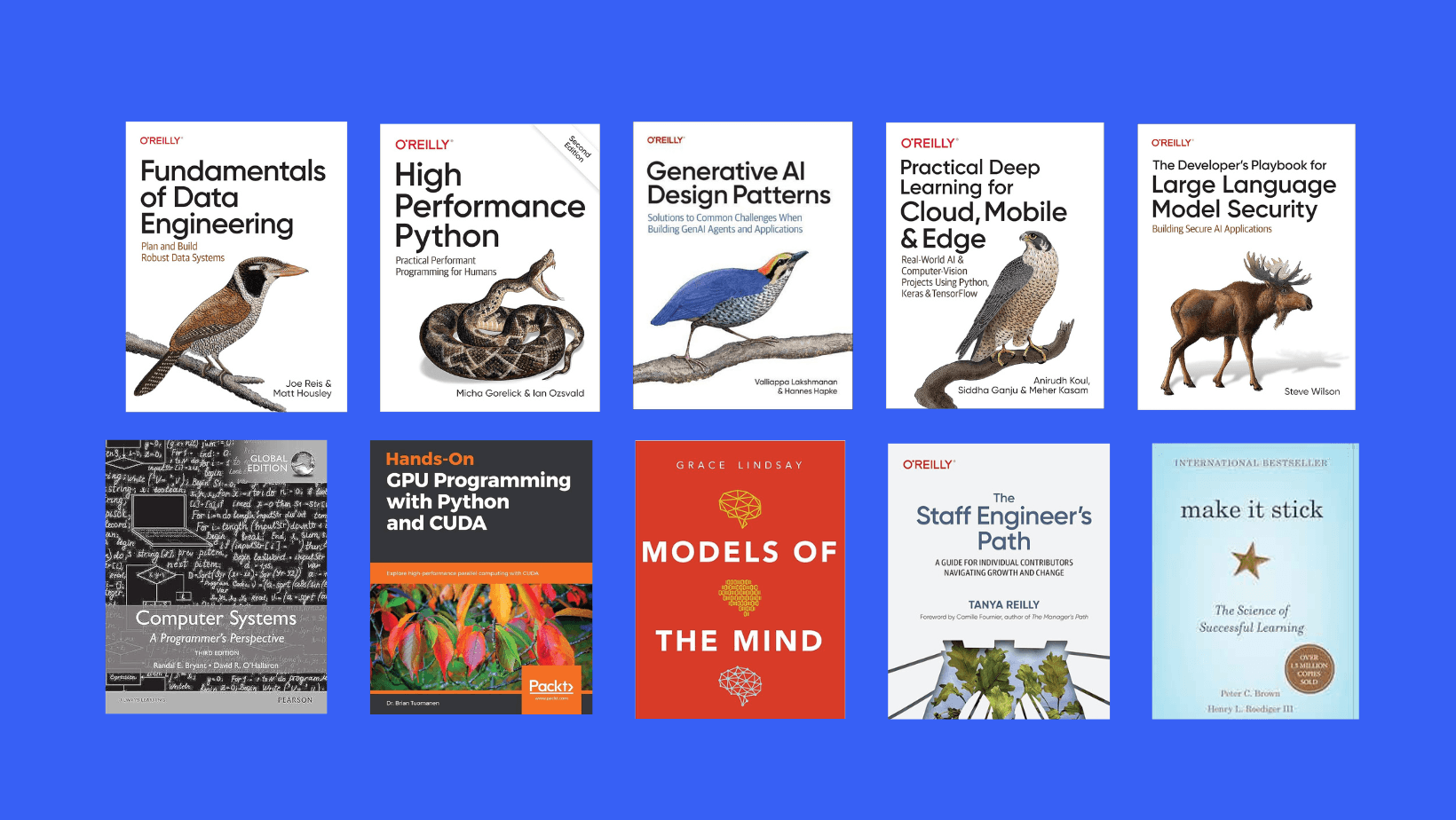
Let’s be honest.
Most of us learn AI like this:
A few blog posts
Some X (Twitter) threads
A couple of YouTube videos
It works for a while.
But at some point, you hit a wall.
You can use tools, but you don’t fully understand them.
You can build things, but debugging feels like guessing.
👉 That’s the difference between:
following AI trends
and building real expertise
Books help you close that gap.
Not because they are “better content”, but because they give you structured, deep understanding.
This list is not about reading more.
It’s about learning what actually compounds over time.
If you’ve ever said: I don’t know why this code is slow.
This book fixes that.
It helps you understand what really happens under the hood.
What you’ll get:
How data is actually stored in memory
What your code becomes at machine level
Why caches and memory matter for performance
How programs are compiled and linked
👉 Why it matters:
You stop guessing
You start reasoning about performance
Even with the best model in the world, if your data pipeline is messy, then your system fails.
This book shifts your mindset from:
reactive fixes ❌
to
intentional system design ✅
What you’ll learn:
The full data lifecycle (ingest → transform → serve)
How to design scalable pipelines
How to avoid breaking things in production
👉 Why it matters:
Data is the real product in AI systems
Python is easy, until it becomes slow.
This book teaches you how to fix that.
What you’ll learn:
How to profile your code (find real bottlenecks)
How to work around the GIL
When to use multiprocessing vs threading
How to speed things up with Cython
👉 Why it matters:
AI systems at scale need efficiency, not just correctness
Most people treat GPUs like magic boxes.
That’s risky.
This book helps you understand what’s really happening.
What you’ll learn:
How GPU kernels work
How CUDA actually runs your code
How to debug slow GPU workloads
How to optimize parallel computation
👉 Why it matters:
Frameworks (PyTorch, TensorFlow) won’t save you forever
Building demos is easy.
Production systems are hard.
This book gives you repeatable patterns.
What you’ll learn:
How to handle hallucinations
How to design reliable LLM systems
Trade-offs between cost, latency, and quality
How to build agents properly
👉 Why it matters:
Production AI is about trade-offs, not just models
Cloud is powerful.
But the future is also:
mobile
edge devices
on-device AI
What you’ll learn:
Deploying models outside the cloud
Working with limited compute
Running AI on devices like Raspberry Pi or Jetson
👉 Why it matters:
Not all systems can rely on cloud infrastructure
This is the one most people ignore, until it’s too late.
What you’ll learn:
Prompt injection attacks
Data poisoning risks
Secure LLM architecture design
Real-world threat models
👉 Why it matters:
One mistake here can break an entire system
This book connects:
neuroscience 🧠
and AI
What you’ll learn:
How the brain inspired neural networks
Why architectures like CNNs exist
The science behind learning systems
👉 Why it matters:
You build better intuition, not just code
It is not obvious going from good engineer “good engineer” to “senior” and then to a “leader”
This book helps you navigate that.
What you’ll learn:
How to set technical direction
How to influence without authority
How to handle ambiguity
👉 Why it matters:
Technical growth is not just coding
Most people learn like this:
read
highlight
forget
This book shows what actually works.
What you’ll learn:
Spaced repetition
Active recall
Mixing topics for deeper understanding
👉 Why it matters:
In AI, forgetting is expensive
Re-learning slows your growth
Build your technical moat
AI is moving fast.
That’s exactly why depth matters more now.
Instead of asking: What’s the latest tool?
Start asking: Do I really understand how this works?
A simple way to start:
Pick one book from this list
Identify your biggest gap
Go deep (not fast)
👉 At Alinme, we share more resources like this to help AI builders:
grow real skills
showcase their work
and create opportunities